
Terrace or corner terrace: what the extra land costs
Corner terraces are not just end units. The side land changes light, privacy, rebuild options and price, but the premium only makes sense for some buyers.
The rule behind the price gap
A terrace house is part of a row. URA describes it as a dwelling house with its own land title forming part of at least 3 houses that abut common boundary party walls. In everyday viewing language, the important difference is simple: an intermediate terrace has neighbours on both sides, while a corner terrace sits at the end of the row and has one open side. That open side is why buyers often feel the difference immediately, even before they study the land survey.
The planning numbers explain why the market treats the two differently. URA’s current terrace Type I plot size and width requirements state a minimum 150 sqm plot and 6 m width for an intermediate terrace, against a minimum 200 sqm plot and 8 m width for a corner terrace. The current landed planning controls also group semi-detached and corner terrace Type I houses together for a 200 sqm minimum plot and 8 m minimum width. Those numbers do not price the house by themselves, but they set the physical starting point.
That is why a corner terrace usually carries a step-change, not a small add-on. The buyer is paying for more land, more width, more light, a side setback and a different future design conversation. My article on the five kinds of landed property gives the broad family tree; this piece is about the narrow but expensive line between two terrace positions.
- Intermediate terrace Type I: current URA minimum 150 sqm plot and 6 m width.
- Corner terrace Type I: current URA minimum 200 sqm plot and 8 m width.
- A corner terrace has one shared party wall and one open side.
- The side condition changes privacy, light, ventilation and rebuilding options.
What the side land really buys
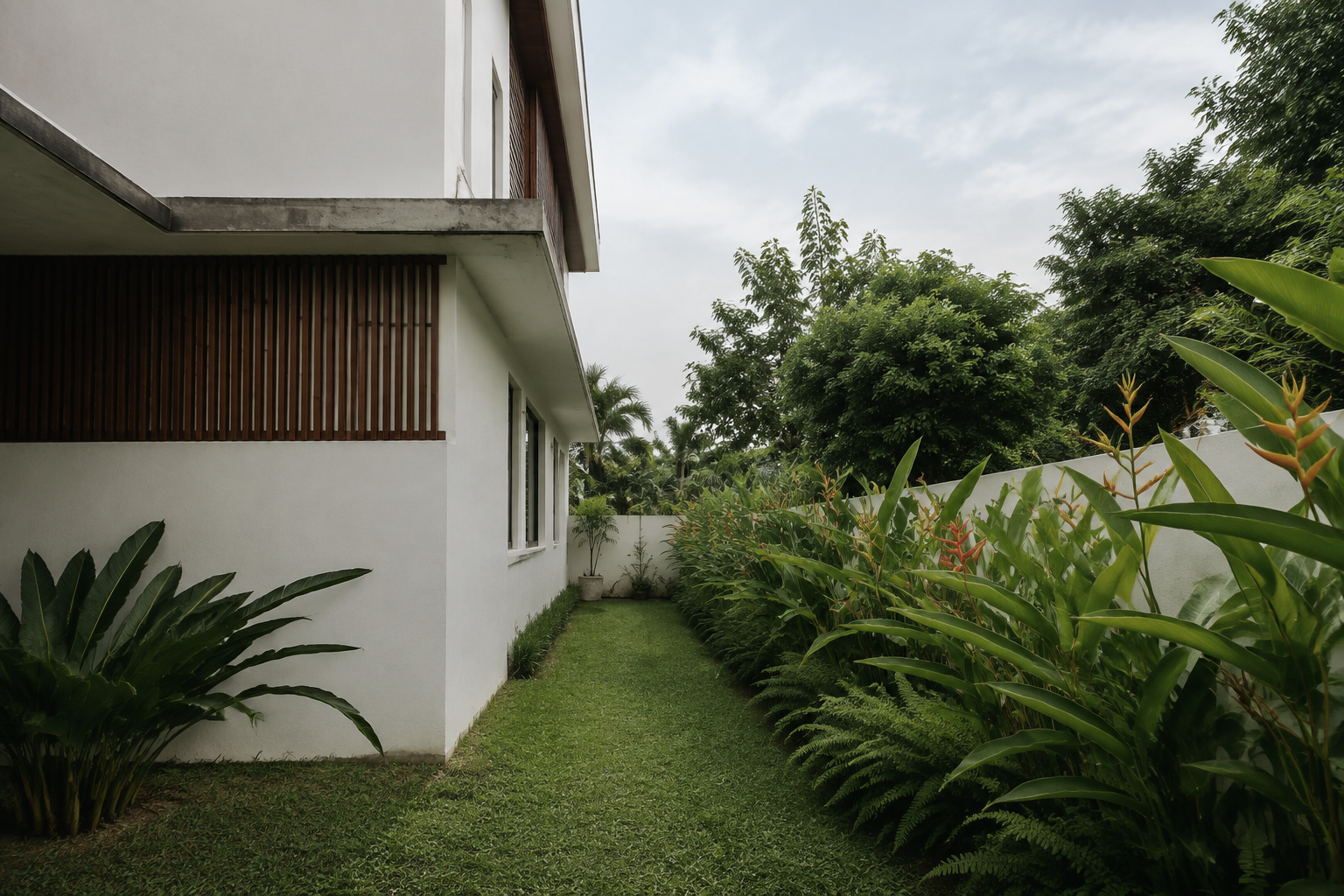
The side land is not automatically usable in the way buyers imagine. It may become a garden, a brighter dining area, a side access route, better cross-ventilation, or simply breathing space from the neighbouring wall. For families with children or elderly parents, that side access can be practical because workers, gardeners or delivery people need not always pass through the living room. For owners who enjoy plants, it can make a narrow terrace feel calmer and less enclosed.
But the side land also comes with controls. URA’s prevailing landed planning controls show front, side and rear setback requirements for corner terrace Type I houses. Setback land is still valuable, but it is not the same as buildable internal floor space. If a buyer pays a large premium because they imagine extending right across the side, the Qualified Person must check the actual controls, road buffer, drainage reserve, easements and envelope before anyone treats that idea as possible.
This is especially important in older Bukit Timah estates. Some plots are regular and generous. Others have odd shapes, slopes, road reserve lines or party-wall complications. In a place where every street has its own rhythm, the Bukit Timah estates guide is a useful reminder that the estate name is only the first layer. The exact plot still has to earn its premium.
Why rebuild potential changes the calculation
Many landed buyers are not only buying the existing house. They are buying the possibility of a future A&A or rebuild. A corner terrace can be easier to imagine because the open side gives more design freedom for windows, stair placement and room planning. URA’s envelope control guidelines still apply, including the relevant two-storey or three-storey height control and setbacks, but the corner condition can make the eventual plan feel less compressed.
The value is not unlimited. If the house is already well rebuilt and the buyer does not need the side garden, the premium may be mostly lifestyle, not future upside. If the corner plot is affected by a drain, a sharp taper, a noisy side road or an awkward entrance, the extra land may not live as well as the number suggests. I always separate land area from usable enjoyment. A larger plot that is difficult to plan can be less attractive than a smaller intermediate terrace with good width and a clean rectangle.
There is also a family-estate angle. After a death in the family, beneficiaries may look at a corner terrace and assume the market will automatically pay more. It often will, but the right comparison is not any terrace nearby. It is the most relevant recent evidence after adjusting for plot size, frontage, condition, tenure, road position and rebuild potential. An inherited corner unit still needs disciplined pricing.
When the premium is not worth paying
The corner premium is weakest when the buyer will not use the side land. If the family wants the lowest entry price into a landed street and is comfortable with a more enclosed layout, an intermediate terrace may be the cleaner choice. If the side boundary faces heavy traffic, a bin point, a substation or a very exposed junction, the theoretical openness may not feel private. If the garden is mostly setback that cannot be meaningfully built over, the buyer should price it as amenity, not extra internal space.
Maintenance is another honest point. More external wall, more garden edge and more exposed roofline can mean more upkeep. That may be perfectly acceptable for a family who values light and space. It may be irritating for an owner who travels often or wants a lock-up-and-leave lifestyle. In Singapore landed housing, every gain has an upkeep line attached to it.
My practical test is simple. Stand inside the house at the hottest part of the afternoon, then walk the side boundary slowly. Ask what the extra land improves today, what it may allow later, and what it costs to maintain. If those answers are clear, the premium may be justified. If the answer is only that corner terraces are rarer, I would be more careful.
What to take from this
- Check the current URA minimum plot and width rules before pricing a terrace comparison.
- Pay for side land only if it improves light, privacy, access or future planning in a way you value.
- Treat setback land as valuable amenity, not automatically as buildable internal area.
- Compare corner terraces against adjusted recent evidence, not against any terrace on the same street.
Questions I get asked about this
Is every corner terrace worth more than an intermediate terrace?
Usually it commands more, but not automatically. The premium depends on land area, width, side condition, road exposure, plot shape, tenure, condition and rebuild potential. A noisy or awkward corner can be less attractive than a well-shaped intermediate terrace on the same estate.
Can I build over the side garden of a corner terrace?
Do not assume so. URA setbacks, road buffers, envelope controls, drainage reserves and other technical requirements may restrict what can be enclosed or extended. A Qualified Person should check the actual site before you price the side land as future internal floor area.
Why does URA use different minimum plot sizes?
The minimums preserve meaningful landed housing forms. Current URA guidelines for terrace Type I houses state 150 sqm and 6 m width for intermediate terraces, and 200 sqm and 8 m width for corner terraces. Those controls shape what can be built and rebuilt.
Should a seller renovate a corner terrace before listing?
Usually, fix obvious defects and present the land clearly before spending on major renovation. Many buyers of corner terraces are evaluating the plot and future design potential. Heavy cosmetic spending may not return its cost if the buyer intends to redesign or rebuild.
Sources
- Terrace Houses — URA
- Plot Size and Width — URA
- Prevailing Planning Controls for Landed Housing — URA
- Envelope Control Guidelines — URA
- Locational Criteria — URA
- Redeveloping to a Semi-Detached House — URA
Written by Karen Lim, CEA Registration Number R005794D, PropNex Realty Pte Ltd (CEA Licence Number L3008022J). Rules, rates and thresholds in Singapore property change; please confirm anything time-sensitive with the relevant authority or with me before you act on it.